A memoir
OvernightA bipolar breakup memoir
When the person you love disappears into bipolar disorder.
Diane's story of the week her marriage ended — plus the practical steps she wishes she'd had on the first night.
Same man. Same kitchen. Same coffee cup on the bench. A different person on the inside.
The premise
Nine years of marriage. Seven days of not sleeping, talking faster, a coldness that kept getting colder. Then one morning, with a flatness that still haunts her: I don't love you anymore. This book holds that week under a microscope — because understanding the mechanism is how Diane got back on her feet, and how you will get yours.
Inside the book
The anatomy of an overnight
What an episode does to love — the appraisal system, the calm, the box.
The first 72 hours, hour by hour
How to keep yourself steady when the ground is still moving.
The crash course on bipolar disorder
Bipolar I, Bipolar II, and why it so often gets missed — in plain language.
Scripts & reflection prompts
The words to say out loud, and the questions to sit with after.
Seven days
He said it on a Tuesday: I can't imagine my life without you.
He stood at the kitchen window and said he felt like he was in a box.
By the following Tuesday, he could not look at me without something close to hatred.
Excerpt
"The thing that frightened me most was the calm. A decision that should have cost him everything seemed to cost him nothing."
Free — no book required
The first 72 hours after a bipolar breakup
The ground is still moving. This short checklist gives you six things to do — and three things not to do — while it settles. It's the same checklist that opens Part Two of Overnight.
Who this book is for
For everyone holding two truths at once: that the person who left you was real, and that the illness that took them was too. Not a clinical manual — a steady voice from someone who has stood in your kitchen.
If you ever sense your partner is in danger, that concern comes before anything in this book.
About the author

Diane writes under a pseudonym, and "Tony" is not his real name — details have been changed to protect privacy. The story is true.First edition, 2026. A work of nonfiction based on personal experience. More about Diane →
Understanding a bipolar breakup
What is a bipolar breakup — and why does it feel so sudden?
A bipolar breakup is the end of a relationship that happens during, or is shaped by, a mood episode in a partner who has bipolar disorder. It often arrives without the usual warning: a manic or hypomanic episode can bring sudden certainty and impulsive decisions, while a depressive episode can bring numbness and withdrawal that feel like love has vanished.
Not every breakup involving bipolar disorder is caused by it — people with bipolar leave relationships for ordinary reasons too. And bipolar disorder is a treatable medical condition; many people with it have long, stable relationships. But when an episode is part of the story, the person left behind is usually shocked, confused, and searching for answers late at night. This site, and Overnight, were made for that moment.
In-depth guides
- What is a bipolar breakup? A complete guide →
- Why a partner with bipolar may end a relationship out of nowhere →
- Bipolar breakup cycles and relationship patterns →
- What happens after a bipolar breakup →
- Do they come back? Bipolar breakup and reconciliation →
- Coping with a bipolar breakup →
- Supporting a partner with bipolar — with healthy boundaries →
- When to get professional mental-health support →
- Bipolar 1 vs 2: what the difference means for your relationship →
How this site can help
- Right now, free: the first-72-hours checklist — six things to do, three to avoid.
- The book: Diane's first-hand account of a nine-year marriage that ended in seven days, with practical tools for the first 72 hours. Get the e-book.
- The readers' forum: share your story and hear from people who've lived it. Visit the forum.
- A personal discussion guide: turn a passage or question into prompts for reflection or a book club. Create one.
Common questions
Bipolar breakup questions, answered
Why do bipolar partners break up out of nowhere?
During a manic, hypomanic or depressive episode, how a person perceives their relationship can change sharply — sometimes within days. The decision can feel sudden and final to them, and baffling to you. It isn't your fault, and it doesn't happen to everyone with bipolar disorder. Read more
Do people with bipolar come back after a breakup?
Some reach out once an episode settles and treatment begins; others don't. Regret is common, but a return is only healthy if it comes with stability, accountability and a plan. Protecting your own wellbeing matters either way. Read more
How long should no contact last after a bipolar breakup?
There's no fixed number. Many people give themselves at least several weeks — long enough for the acute episode to pass and for their own nervous system to settle — and extend it if contact keeps reopening the wound. Read more
Can a breakup trigger a bipolar episode?
Major stress, including a breakup, and disrupted sleep are recognised triggers for mood episodes in people who already have bipolar disorder. Keeping routines, sleep and treatment steady is especially important afterwards. Read more
When is it time to walk away from a relationship with someone who has bipolar?
When you are unsafe, when your own health is suffering, or when your partner is unwilling to engage with treatment. Compassion for an illness and protecting yourself can exist at the same time. Read more
What's the difference between bipolar 1 and bipolar 2 in a relationship?
Bipolar 1 involves full mania, which can bring sudden, high-energy breakups. Bipolar 2 involves milder hypomania and long depressions, where endings more often come from slow withdrawal. Treatment and a shared plan matter more than the type. Read more
If you're in crisis
This book is a companion, not care. If you or someone you love is in danger, call 000 (Australia), 911 (US) or 112 (UK/Europe) — or your local emergency number — any time, day or night.
Get the book
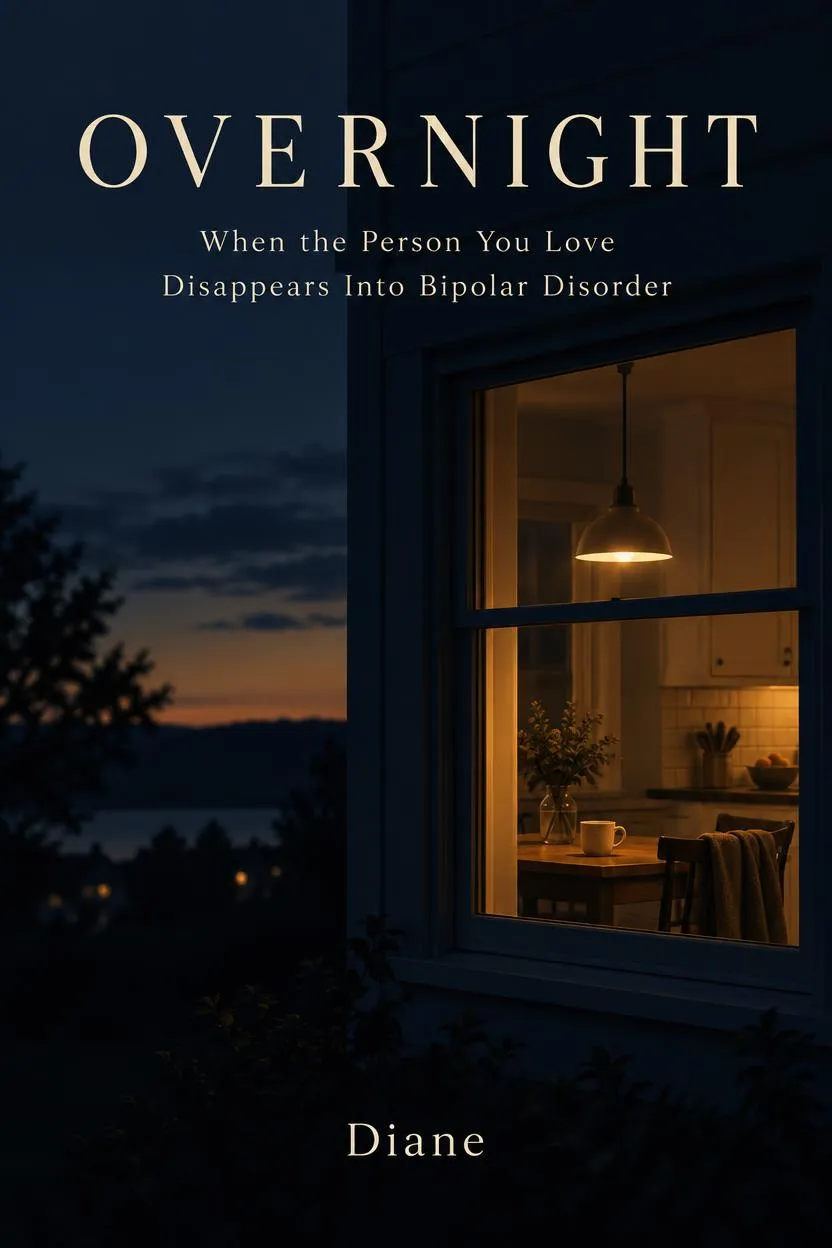
A steady hand for the night after.
Overnight is an instant-download e-book. You'll be reading within minutes of checking out — tonight, not next week.
$49one-time payment · no subscription
- The full memoir: nine years, seven days, and the aftermath — 229 pages
- The first-72-hours guide, hour by hour, for the night it happens
- Scripts and reflection prompts for the conversations you're dreading
- Instant PDF download — read on your phone, tablet, computer or e-reader
- Your download link is locked to your email and stays live for 30 days
E-book · Instant download · Secure checkout